
The what? The who? We need how many of what-now?
If you're not sure of the difference between porters, guides and those in between, trying to work out who you need on your team for a trek can be tricky. We know this, so to make life easier for you we've written the following guide.
There's also a handy quick reference table at the end of the page, so you can come back any time and remind yourself without having to read the whole article.
One thing to know before you choose: a guide and a porter-guide both satisfy Nepal's licensing rules for foreign trekkers, and a porter does not. See do you need a guide to trek in Nepal for what the rule asks of you.
Jump to quick reference Find my trekking Guide or Porter
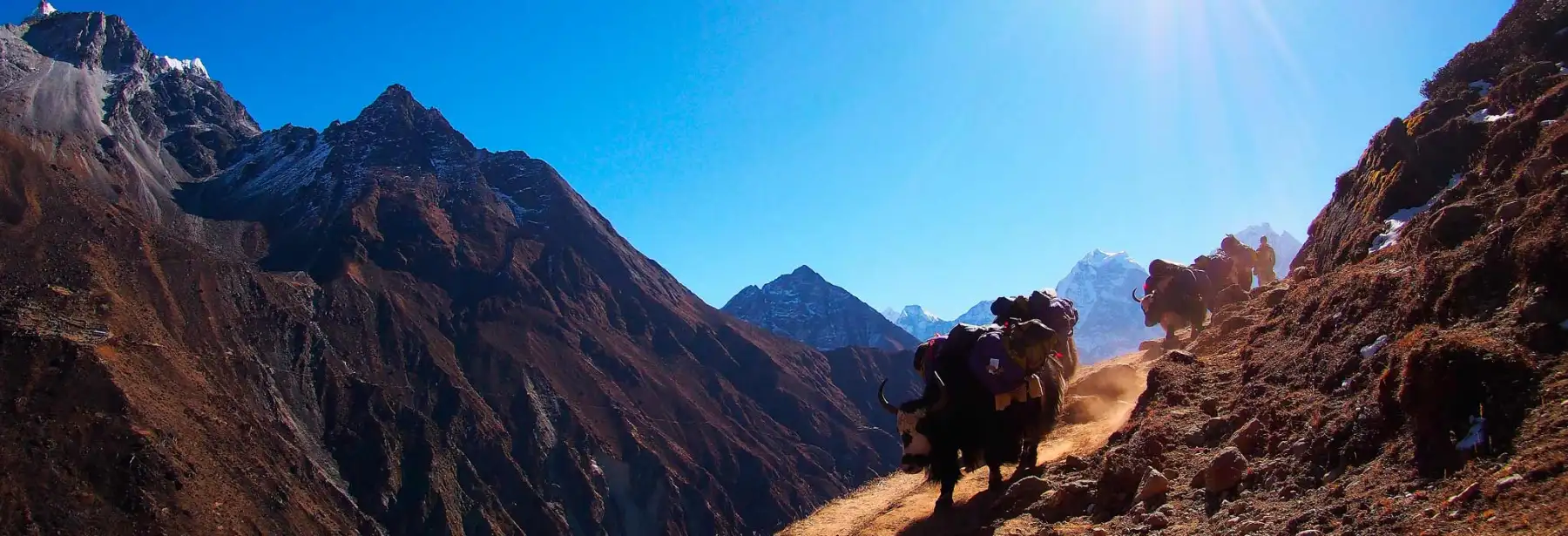
 They're there to show you the way, to point out the famous mountains, landmarks and of course, dangers. They're there to keep you safe, to fascinate you with tales of local lore and wild adventurers. They're there to make sure you get good food and a clean bed in every village and to make sure you have the best possible experience on your trek.
- They're not there to carry your stuff.
A good guide can sometimes be hard to find (which is one of the reasons we started our guide finding service), but when you find one they'll usually be happy to help you find porters (most of whom speak little or no English or other languages, so unless you know some Nepali, this can be very difficult), sort out park passes and permits, get you into the mountains and work as a general manager for your porters and other staff each day, where you may otherwise struggle. Some of these additional services may come with a small fee to cover your guide's time and travel costs to the various booking offices and government departments. Your guide is essentially your mountain concierge and having one is likely to make your trip more pleasurable in every way.
It's important also to treat your guide with respect and acknowledge the experience and wisdom they possess. The best guide-trekker relationships are always those that begin with mutual respect and blossom into friendship, trust and laughter. That is in fact the very foundation from which this company came into being.
For safety, fun, local knowledge and to support the country that inspires such awe for all of us, we'd always recommend trekking with a guide.
Porter
 Porters are literally the backbone of the trekking world. Everything you see in the mountains that nature didn't put there – a porter did. For trekkers, the trail can be hard, the air thin, and the gear REALLY heavy. Porters, especially Sherpas and other mountain peoples, are accustomed to the altitude and thin air (many even have different physical characteristics from you and I - special adaptations to cope) and spend their lives carrying loads in the mountains. For you, heavy pack of gear might make a tough day unbearable – a good porter won't have too much difficulty. If you ask them, porters will carry immense loads, much more than could be considered reasonable – it's up to you to exercise discretion and care. We suggest not asking any single porter to carry more than 18kg – a safe weight they can manage with comfort. A porter will typically carry the gear of two people when teahouse trekking in Nepal, or one person or less when on a camping trek.
Porters aren't there to guide you, most don't even speak English, they're just there to make sure everything you need is where you need it, when you need it. They're also not there to look out for your safety – in fact, porters are often so keen to get the job done that you need to look out for their safety and well-being. Especially on a DIY trek, as their employer, you have a genuine responsibility for their health and safety.
Porter-Guide
 Not as common as either specific porters or guides, though some guides will operate as porter guides when times are tough. Porter guides will speak some English, offer you some trail guidance and carry some of your gear. They provide a balanced service, when you don't need the full blown services of a dedicated porter and guide. You could expect a porter-guide to carry around 10kg for you on top of their own gear and help make sure you stay on the trail you're supposed to be on.
Quick Reference Porter / Guide Comparison
Of course, this won't be accurate in all cases, but for planning purpooses this is what you may expect from each member of your team:
|
Speak English / Bilingual |
Carry Your Gear |
Pre-trek help |
Help on the Trail |
Max trekkers per staff member |
Approx. daily cost |
|
|
Guide |
Yes |
No |
Yes |
Yes |
4 |
$28 |
|
Porter-guide |
Maybe |
10kg |
No | Some |
2 |
$24 |
|
Porter |
No |
18kg |
No |
No |
2 |
$22 |
Find my trekking Guide or Porter
Common questions about guides and porters
Do I need both a guide and a porter?
Not necessarily. A guide is what the rules require, and a porter is a comfort decision. Plenty of people trek with a guide and carry their own gear. If you would rather not, one porter comfortably serves two trekkers on a teahouse trek, so a pair sharing costs about half of what the table above suggests each.
Is a porter-guide enough?
For most teahouse treks, yes. A porter-guide is licensed, speaks some English, keeps you on the right trail and carries around 10kg for you. It is the cheapest arrangement that satisfies the rules and still takes weight off your back. What you give up is depth: a dedicated guide knows the history, handles the permits and the paperwork, and manages the rest of your team.
How much should a porter carry?
We suggest a maximum of 18kg, which a fit porter manages comfortably. You will see far heavier loads on the trail. That is not a standard to aim at, it is the problem. As the employer on a DIY trek the weight is your decision, and so is the responsibility that comes with it.
Can I hire a porter without a guide?
You can hire one, but it will not satisfy Nepal's trekking rules, because a porter is not a licensed guide. If cost is the reason, a porter-guide is the answer rather than a porter on their own. See do you need a guide to trek in Nepal.
Do porters speak English?
Most do not, beyond a few words, which is exactly why guides and porter-guides exist as separate jobs. It also means a porter cannot be your interpreter at a teahouse or your negotiator at a checkpost, and should not be asked to be.
How many trekkers can one guide look after?
Four is our limit for a guide, and two for a porter-guide. Beyond that nobody gets much attention, which rather defeats the purpose on the days when attention is what matters.