
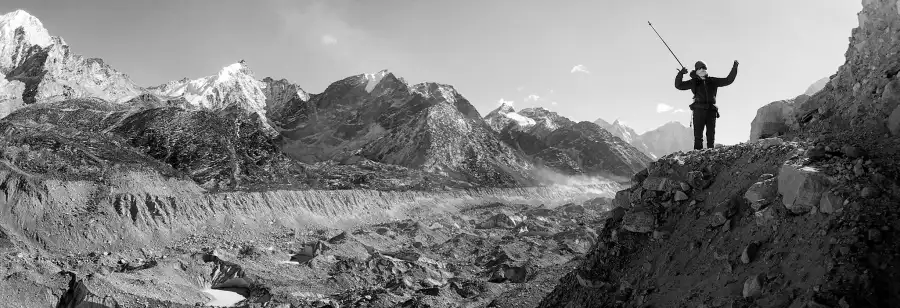
Twenty days to both sides of the world's third highest mountain, in the far east corner of Nepal where almost nobody goes.
Kanchenjunga is 8,586m, the third highest mountain on earth, and it sits in the top right corner of Nepal on the Sikkim border, about as far from Kathmandu as the country allows. Getting there takes a flight to Bhadrapur in the tea country of the Terai and then two days of driving north into the hills. That journey is the whole reason this trail is empty. The Khumbu takes tens of thousands of trekkers a year. Kanchenjunga takes a few hundred.
The circuit goes up the Ghunsa valley to Pangpema, the north base camp at 5,140m, under a wall of ice that people who have seen both say is more imposing than anything at Everest Base Camp. Then it crosses west over the Sele La to the Yalung side and up to Oktang, looking at the south face across the glacier. Two base camps, one mountain, one trek.
What you get in between is eastern Nepal: Limbu villages low down, Tibetan Buddhist ones higher, forests of rhododendron and bamboo that are genuinely wild rather than managed, and red panda country around Ghunsa that you will almost certainly not see a red panda in.
Our local staff are paid a decent living wage, get provided with all the right gear and are always well looked after. We pride ourselves on this.
Why this is filed off the beaten track
Everything else on this page of the site is lowland and easy. Kanchenjunga is neither, and it is here for the other half of what off the beaten track means: no crowds, no infrastructure to speak of, and a long way from help.
Be clear about what that costs you. The lodges above Ghunsa are simple and seasonal, and some nights are closer to a shed with a stove than to a Khumbu teahouse. There is no reliable phone signal for most of the trek. There is no helicopter on twenty minutes' notice: an evacuation from Lhonak is a serious, slow and expensive undertaking, and the nearest hospital worth the name is days away. On the Everest trail an altitude problem means walking down to Namche. Here it means walking out the way you came in. That is the trade, and it is why we ask for previous high altitude experience on this one and why your insurance needs to cover helicopter rescue above 5,000m in a remote area. Our travel insurance page covers what to look for.
Permits, and the rule that changed
Kanchenjunga is a restricted area. You need the Kanchenjunga Conservation Area permit at NPR 3,000, and the restricted area permit at US$20 per person per week, which on a twenty day trek means three weeks and US$60. Both are arranged through a registered agency against a named licensed guide and cannot be bought by a trekker directly, under any circumstances.
Worth knowing if you are researching this trek on older pages: restricted area permits used to require a party of at least two, which meant a solo trekker had to find someone or pay for a phantom second permit. That requirement was removed in March 2026 across all of Nepal's restricted districts, Taplejung included, so one person can now hold a Kanchenjunga permit. The licensed guide and the registered agency are still mandatory and are not going anywhere. Restricted area fees are reviewed periodically, so we confirm the current figures with your quote. The full list is on permits and park passes.
Itinerary
Fly to Bhadrapur, drive to Taplejung 1820
An early flight east to Bhadrapur on the Indian border, and then eight to ten hours by road climbing out of the Terai through tea estates and hill villages. It is a long day and there is no shorter version of it. Taplejung is the district town and the last place that feels connected.Taplejung to Sekathum 1640
Six to eight hours on a rough mountain road following the Tamor north. Sekathum is where the road gives up and the walking starts.Sekathum to Amjilosa 2510
Five or six hours up the Ghunsa Khola, crossing and recrossing on suspension bridges, climbing steeply through bamboo, rhododendron and pine. Amjilosa is a handful of houses on a shelf above the river.Amjilosa to Gyabla 2725
Five or six hours through dense forest with the river a long way below, some exposed sections, and waterfalls coming off the walls of the gorge. Gyabla is a small Tibetan settlement in a clearing.Gyabla to Ghunsa 3415
Five or six hours and the day the valley opens. Forest gives way to pine and pasture at Phale, a Tibetan refugee village, and then Ghunsa: wooden houses, prayer flags, a gompa and a micro hydro scheme. It is the biggest village on the trek and the last one of any size.Ghunsa, acclimatisation day 3415
A rest day and a working one. A climb a few hundred metres up the valley side and back, the gompa, and time to eat properly before the ground gets serious. Ghunsa is also where a memorial stands to the twenty four conservationists killed in a helicopter crash here in 2006.Ghunsa to Khangpachen 4050
Six or seven hours following the river past a landslide section that takes care, through the last of the trees and out into open moraine country. Jannu appears ahead, which is the moment the trek changes gear.Khangpachen to Lhonak 4780
Six or seven hours on a demanding, barren day up the side of the Kanchenjunga glacier. Nothing grows. Lhonak is a scatter of huts on a sandy flat, cold and exposed, and it is where the altitude tells you what it thinks of you.Pangpema and back 5140
Seven to nine hours out and back to the north base camp at 5,140m, along the moraine with the glacier below and Kanchenjunga's north face rising four kilometres in front of you. Wallanchung Gola, Chang Himal and Nepal Peak line the rim. Back to Lhonak for the night.Lhonak to Khangpachen 4050
Six or seven hours retracing the valley, and much easier for it. Thicker air, warmer, and a chance to look at everything you were too breathless to notice on the way up.Khangpachen to Ghunsa 3415
Six or seven hours down through the moraine and back into the trees to Ghunsa. A real night's sleep.Ghunsa over the Sele La to Tseram 4480
Eight to ten hours and the hardest day of the trek. A steep forest climb out of Ghunsa, then a series of passes on the ridge, of which the Sele La at about 4,480m is the highest, in country with no shelter and weather that changes fast. Then a long descent to Tseram on the Yalung side. If a day gets moved for weather, it is usually this one.Tseram to Ramche 4580
Five or six hours up the Yalung valley beside the glacier, through Yalung base camp country and onto the high pasture at Ramche. Kabru and Rathong sit above you.Oktang and back 4730
Seven to nine hours out and back along the Yalung glacier to the Oktang viewpoint, looking straight at the south face of Kanchenjunga. This is the other half of what you came for, and on a clear morning it is the better of the two.Ramche to Tseram 3870
Five or six hours back down the valley, losing height and getting the greenery back.Tseram to Yamphudin 2080
Seven to nine hours, a long descent through Tortong and over the Lasiya Bhanjyang into forest and then farmland. Yamphudin is a real village with fields around it, and after two weeks above the treeline it feels like arriving somewhere.Yamphudin to Khebang 1700
Six to eight hours through terraced hillsides and Limbu villages, subtropical again, with cardamom drying by the path.Khebang to Birtamod 140
Eight to ten hours by road out of the hills to the Terai. A long, dusty, hot day and the last of the mountains behind you.Fly back to Kathmandu 1400
An hour to Bhadrapur airport and a short flight west to Kathmandu. Hotel, hot shower, and something that is not dal bhat.Departure 1400
Transfer to the airport for your flight home, whenever it is. If you have the time, use the day: it is a poor idea to build a twenty day trek in the far east with no slack in it at all, because the Bhadrapur flights do get delayed.
What's included
- Hotel in Kathmandu on the night before the trek
- Welcome dinner, briefing and cultural show the night before the trek
- Return flights between Kathmandu and Bhadrapur
- All ground transport between Bhadrapur, Taplejung, the trailhead and back
- Hotel in Kathmandu on the night after the trek
- Airport meet & greet on arrival into Kathmandu
- Teahouse and simple lodge accommodation during the trek
- Breakfast every morning (except arrival day of course)
- Hot drink of your choice every morning
- High quality sleeping bags provided for trek
- English speaking, skilled & experienced Nepali group leader
- Ample additional English speaking guides for the group
- Well paid local porters to carry your gear
- Proper, quality mountain gear to keep our porters safe and warm
- Insurance of all staff, including porters
- Kanchenjunga restricted area and conservation area permits
- Full pre-departure briefing and trip information
What's not included
- International flights / transport
- Nepal visa fees (payable on arrival)
- Trekker's travel insurance, which must cover remote high altitude rescue
- Evening meals, drinks and luxuries on the trek
- Personal needs (e.g. laundry, postcards)
- Tips for your Guides & Porters
Common questions about the Kanchenjunga trek
How hard is the Kanchenjunga Circuit compared with Everest Base Camp?
Harder, and mostly not because of the altitude. Pangpema at 5,140m is lower than Kala Patthar, but this trek is a week longer, has far more days over six hours, crosses the Sele La ridge with no lodges on it, and has a fraction of the infrastructure behind it. Everest Base Camp is a hard walk on a well served trail. This is a long expedition on a thin one.
Do I need previous high altitude experience?
We ask for it. Twenty days, eight nights above 4,000m and an evacuation that is measured in days rather than hours is not the place to discover how you get on above 5,000m. If Kanchenjunga is the goal and you have not been high before, do Everest Base Camp or the Annapurna Circuit first.
Can I trek Kanchenjunga solo?
One trekker can now hold the permit. The rule requiring a party of at least two was dropped in March 2026 across every restricted district in Nepal. What has not changed is that the permit is only ever issued to a registered agency against a named licensed guide, so solo means you and a guide rather than you and nobody. Out here that is not a formality, it is the reason an evacuation would work at all.
What do the permits cost?
NPR 3,000 for the Kanchenjunga Conservation Area permit, and US$20 per person per week for the restricted area permit, so US$60 across a twenty day trek. We arrange both. Restricted area fees change more often than the park fees, so we confirm them with your quote.
Can it be shortened?
Yes. Dropping the southern half and walking out the Ghunsa valley from Pangpema saves about five days and still gives you the north base camp, and it is the version to look at if you cannot free up three weeks. You lose Oktang and the Sele La, which is the harder day and one of the better ones. Ask us and we will price both.
When can it be walked?
Spring and autumn only in practice. Autumn, from late September to November, is the most reliable for the views. Spring brings the rhododendron forests out in the lower valleys and is the other good window. The Sele La holds snow into spring and shuts in winter, and the monsoon brings landslides to the road from Taplejung as well as leeches and cloud. See when to trek in Nepal.